Showing posts with label student praise team. Show all posts

Tuesday, 28 November 2017

Which road are you taking?

Chapel speaker Mike Gordon told a story during Tuesday’s Spiritual Emphasis Week chapel about the day he was walking down the street in Toronto with some friends when he came upon a small blue bird on the sidewalk. After several efforts to pick up the bird and carry it safely out of harm’s way, Gordon and his friends used a twig as a perch and carried it back to the student council office at their school.

 
Once in the cramped office, “this little bird decided ‘now is a good time to start flying;’ “ Gordon said, as the bird took flight and a game of “human dodgeball” ensued. In its frenzy, the bird smashed into a wall of the office and died.
“Worst. Story. Ever.” Gordon admitted.
But the bird’s struggle and death illustrate an important question, he said. Would the bird, which had obviously been someone’s pet, have been better off in the wild, or in a cage?
“What would lead to the best possible life for the bird?” Gordon asked. “To live freely, without restrictions, or to live with constraints?”


Gordon said Jesus posed a similar question in Matthew 7:13-14, as he was concluding what has come to be known as The Sermon on the Mount. Speaking to an audience of people with diverse backgrounds and experiences, Jesus knew that every one of his listeners, just like the students at Smithville Christian High School, are searching for something. “Everyone has a different story, but we are all searching for truth, we are all searching for life,” Gordon said.
Jesus told his listeners that there are two ways to live: the broad way and the narrow way.
“Enter through the narrow gate. For wide is the gate and broad is the road that leads to destruction, and many enter through it. But small is the gate and narrow is the road that leads to life, and only a few find it,” the students read out loud.
The broad way is a life without rules or constraints, and fits well with our post-Christian, post-modern culture, Gordon said. “Live whatever way you want. There is no truth, so there are no consequences, do what you want, it’s all good.”
It’s epitomized in the acronym YOLO: you only live once.
“On the surface, it looks easy, it looks popular, it looks attractive. It’s tempting.”
Meanwhile the other road – submitting your life to God – is not as easy to follow and there don't seem to be as many people on it.
Travelling that road, “you might get made fun of, you might feel like you are the only one.”
But many of us don’t look at where the path we are on is going to lead, Gordon said.
“This Scripture is not talking about where we go when we die. It’s not talking about the end of life, it’s talking about lack of life.”
Gordon said when he was a teenager his parents’ marriage fell apart and he got kicked out of the house his mother shared with her new boyfriend. He moved in with his father, who didn’t care where he was, who he was with, or what he was doing.
“So I got involved with what looked good at the time,” Gordon said. Soon he was living on the street, using drugs and alcohol, committing crimes.
“At the moment, it seemed fulfilling, easy. Everyone was doing it.”
But in truth, he was experiencing hopelessness, “a lack of life.”
Gordon said he hoped that the students at Smithville Christian High School realize that Jesus is not lying about where the road leads.
“When you are at that party, in that relationship, at work, with this group of people – what road are you on?” he asked.
If it’s the narrow road, “keep going. This is the road that leads to the best possible life you could have.”
Even if you see things on the other road that seem tempting, fix your eyes on Christ, know the truth. What you are searching for is on this road.”
But it could also be that you are on the wide road, or that some aspect of your life is not being submitted to the LORD God, Gordon said. If that’s true, you need to know that eventually “it’s not going to fulfill you the way that you think it will.” It may seem fun in the moment, but it’s temporary. “If you are on this road, it’s not going to lead where you think it is.”
Gordon said some students may know the hopelessness, emptiness and brokenness that he’s talking about.
“But no matter how far you’ve gone down that road. No matter what you said, or what you did, Jesus is standing there with his arms wide open. He is still loving you. So what do you want: life or destruction?”
* * *

 
Members of student praise team Elucidate led in worship with “I Am Free,” “Great Are You Lord,” and “Multiplied.”

 
* * *
During Spiritual Emphasis Week, chapel is held every morning at 9 a.m. All are welcome to attend.
* * *
Here is a summary of the message in Mandarin.
 同学们,你们好! 这是今天信息的主要内容。
      今天讲员用一个他与鸟的故事开始,阐述鸟本应生活在大自然,却成为人的玩物最后惨死。细察我们的人生也如此,神造我们有目的,有规矩。可世界又有另一套规矩迷惑我们,以至于我们失去了方向,迷失在世界中。
      马太福音 7:13-14 们要进窄门。因为引到灭亡,那门是宽的,路是大的,进去的人也多; 引到 生,那门是窄的,路是小的,找着的人也少。
       这里指的是两种人,一种要进窄门的人,一种要进宽门的人。进窄门的,路是小的,当然就不容易,要付上一定的代价。进宽门的,路是大的,当然就容易些。目的地也是两个完全不同,进窄门的,付了一定代价去的是有益处的; 宽门,大路去的却是无益处的。就向人生中你与别人同样聪明但你比别人更努力,当然你的结果就要别人好一样的道理。
        马太福音这里还告诉我们这窄门是主耶稣为我们打开,成就的。唯有借着主耶稣才能回到起初神造我们的美好,我们才可能明白活着的真正意义及目的。神说只要我们回转,不管我们过去如何,祂都不在意,祂一直盼望我们回到祂的身边,衪用永远不变的爱来爱我们。你愿意吗?


Friday, 25 November 2016

This is what hope looks like

One of Laura de Jong’s “all-time favourite movies” is Princess Bride.

The 1987 film is a story within a story, de Jong said, with a grandfather reading a story about pirates and princesses to Fred, his grandson, who is sick in bed. As the story ends with the good guy dying and the princess marrying the evil prince, Fred protests.

“Grandpa, you read it wrong!” he says. “That can’t be how it ends! She can’t marry the prince. She doesn’t love him. And what about Westley? He can’t be dead!”

De Jong said the movie scene shows that we all have a pretty good idea of how stories should end. “There should be triumph, right should conquer wrong, the hero should get the girl. We know a good ending when we see one.”

De Jong’s final message during Spiritual Emphasis Week 2016 focused on the final chapter of Jeremiah, which, like the story in the movie, had a similarly bad ending. The king is still in captivity, the country is still under foreign occupation and the people are still exiled.

The last few verses of Jeremiah 52 end with forgotten King Jehoiachin being released from prison and dining at the table of the invading king.

“Still an exiled king, still technically a prisoner. Eating fish and dates and drinking wine with the enemy until the day he dies,” de Jong said. “If I was an Israelite, this would seem like an unsatisfactory ending to me.”

After chapters and chapters of God warning the Israelites of the consequences of their unfaithfulness, of capture, exile and occupation, and of God’s promise of restoration, the ending seems anti-climactic and unfinished. And that’s not the only unsatisfactory story we see. We turn on the news and see stories of out-of-control wildfires, villages being bombed, racist attacks or children sold into slavery by their impoverished parents. We look around us and see cancer, family breakdown, or parents who lose their jobs.
Like the people of God at the end of Jeremiah, we are “still in limbo,” she said.

De Jong said the story of Jehoiachin dining at the king’s table is an example of “anamnesis” and “prolepsis” – Greek words for lived memory (anamnesis) and lived future (prolepsis). A modern example of anamnesis and prolepsis would be turning up the heat and having an impromptu Hawaiian party in the dead of winter, complete with barbecued food, flip flops and dance tunes. The party is both remembering what summer feels like (anamnesis) and a bold declaration summer will come again (prolepsis).

That’s what is happening at the end of Jeremiah. The writer is emphasizing that despite his captivity, Jehoiachin is still the king of Judah and he is still in the lineage of David – and Jesus.

“And though captive, we see a glimpse of what things were like before – fine clothes, good food and a seat of honour,” she said. Jehoiachin is acting out a memory of the time when God’s people lived in God’s favour.

These verses also represent an invitation to all of us to live into God’s promise, she said. Jehoiachin’s dinners at the king’s table are a reminder of God’s promise of another king, and indeed, Jehoiachin is mentioned in Matthew 1 in the genealogy of Jesus.

“For the people of Israel, hope looks like King Jehoiachin eating at the table of the king,” she said.
For the people of God, in all times and in all places, hope still looks like a table – a communion table or a library table or a classroom table.


“It’s all the places and times we gather together and offer love and courage and hope to each other through our small acts of service and love,” de Jong said. “We are the body of Christ and we remind each other that God is faithful.”
“God is faithful, and the end of the story is a good one,” de Jong said, because God is good and he loves us. Even when we mess up, run away or yell in anger, God loves us, and invites us to live in the goodness of his new creation. Even if things are going wrong, we get to practice the end of the story.
Whenever we, as Christ-followers, act out the ending and live the goodness, joy, peace and love of the Kingdom of God, we are showing the world and each other how good it will be, de Jong said.
“That’s what hope looks like.”

DeJong said she had a great week at Smithville Christian, and took a selfie with the school.
Spiritual Life Director Gord Park prayed a prayer of thanks and blessing over de Jong as she finishes her studies at Calvin Theological Seminary.

"God's word came through you to us," he said. " You revealed Jesus to us."

Click here to read more about where Laura de Jong's been and where she's going.
* * *
A student praise team led in worship with "Love Come Down," "Holy (Wedding Day)," and "I'm Not Ashamed." We are so blessed by the musicians and AV technicians who make worship possible every day during Spiritual Emphasis Week. Join us for chapel every Wednesday morning -- everyone is welcome.


Thursday, 24 November 2016

It looks like nonsense but it's really hope

Sometimes Christians do goofy things, students at Smithville Christian High School were told at today’s chapel. 
 “One of my favourite coffee table books is ‘Stuff Christians Like,’” said speaker Laura de Jong at the fourth chapel of Spiritual Emphasis Week 2016.

The book contains descriptions of things Christians do that might seem baffling to others, she said. Side hugs, knowing how to avoid being asked to lead a group prayer,  leaving room for the Holy Spirit at a high school dance or using a Christian pick-up line like: “I was reading through the Book of Numbers and realized I didn’t have yours.”

Sometimes these things are funny but often they make no sense to others, de Jong said. That is what was happening in Jeremiah 32. The prophet was asked to do something – buy his cousin’s field – that made no sense.
Jeremiah had run afoul of the king and was under a form of house arrest, the Babylonian king was about to invade and make the land worthless, yet Jeremiah obeyed God and fulfilled the Israelite custom of redeeming a family member’s property.

But Jeremiah’s “nonsensical economic exchange made a bold statement about the future,” de Jong said. The Israelites were in trouble, but Jeremiah’s purchase “was a concrete, tangible sign of hope.”

There are more things – not in the coffee table book – that Christians do that do not make sense to the rest of the world, she said.

They believe that to receive, they must give.
To gain strength they must surrender.
To succeed they have to learn to fail.
To find themselves they must lose themselves.
To fulfill themselves they must forget themselves.
To live is to die to self.
To be first is to be last.
They give away 10 per cent of what they earn, they spend hours a week in church, and look for answers to today’s problems in a 2,000-year-old book.

Sometimes, she would prefer to focus on clothes, music or popularity instead of a relationship with Jesus, de Jong admitted. 

“I want to fit in to this me-first, celebrity-driven, power-hungry world.”

But it’s better to live more like Jeremiah.

“We are people who anticipate a future beyond the realities of this world,” she said. “We know that the day is coming when the backwards, upside-down kingdom of God” takes over and makes all things new.

“We live in the hope of a fully restored earth, a new creation.”

Until then, we live as “already, but not yet” citizens of a kingdom, opening ourselves up to the power of the Holy Spirit, and living not for personal advancement or fame but in order to tell the whole world that there is hope.

*  *  * 
A student praise team led in worship with “We Were Made to Thrive,” “Multiplied,” and “Come as You Are.” 

Spiritual Emphasis Week concludes with a final chapel on Friday at 9 a.m. and a concert at 1:15 with FM Reset. All are welcome.


More about Laura de Jong            
Laura de Jong grew up in St. Catharines, and attended Beacon Christian High School. She studied History, English, and Congregational Ministry Studies at Calvin College in Grand Rapids, Michigan, where she also led worship and worked in residence life. Laura is finishing up her Masters of Divinity at Calvin Theological Seminary, and hopes to do church ministry after graduation. She's a staunch defender of all things Canadian, is enjoying finally learning how to cook, and believes next year belongs to the Blue Jays.

To contact Laura de Jong or to find out more about where she's been or where she's going, check out LauradeJong


Wednesday, 23 November 2016

We are not here to go to heaven

Spiritual Emphasis Week speaker Laura de Jong has spent the past seven years living in the USA, where she says she has endured every Canada joke and Canadian stereotype “known to humankind,” she said.

“For example, what do the Toronto Maple Leafs and the Titanic have in common?” de Jong asked. “They both look good until they hit the ice.

“Or, how do you get a Canadian to apologize? Step on their toe.”

Speaking at the Wednesday chapel at Smithville Christian High School, de Jong said her experience of living in the USA is similar to what God’s people were experiencing in the time of Jeremiah: they were aliens, living in a strange land.

De Jong outlined the story of the Babylonian conquest, of the exile of the people, and of Jeremiah’s surprising prophecy – found in Jeremiah 29. Instead of prophesying his normal message of doom and gloom, Jeremiah tells the people to settle down, get married and plant gardens.

“You are here for the long haul,” de Jong said Jeremiah told the people. “Get comfy.”

And don’t just worry about yourselves, de Jong said. “Seek the peace and prosperity of the city, for if it prospers, you prosper.”

That message was shocking to the Israelites because they preferred to see their captors as the enemy and themselves as victims, she said. But God had a different message. He “wanted his whole world to flourish.”

Like the Israelites in Babylon and like de Jong in the USA, “we are also people living in a land that is not our own,” de Jong said. At our baptisms or dedications, we became citizens of the kingdom of God, making us “resident aliens” of the places we now live. “We are citizens of heaven, this is not our home.”

But just as the Israelites were to seek the peace and prosperity of their city, we are to do the same. We can’t live as if we’re waiting for heaven, or put all our effort into getting to heaven, or sit back and hide out in our comfortable, Christian huddles. The water of baptism signifies that we have been washed, and sent out to get our hands dirty, not to feel superior and think we have it all figured out.

Like genteel society woman, Frances Perkins, who turned a tragic 1911 New York City factory fire into a lifelong mission as a labour activist to improve worker safety, we are to work for the benefit and blessing of those around us, de Jong said.

“We are marked out for heaven and thrust into the business of earth.”

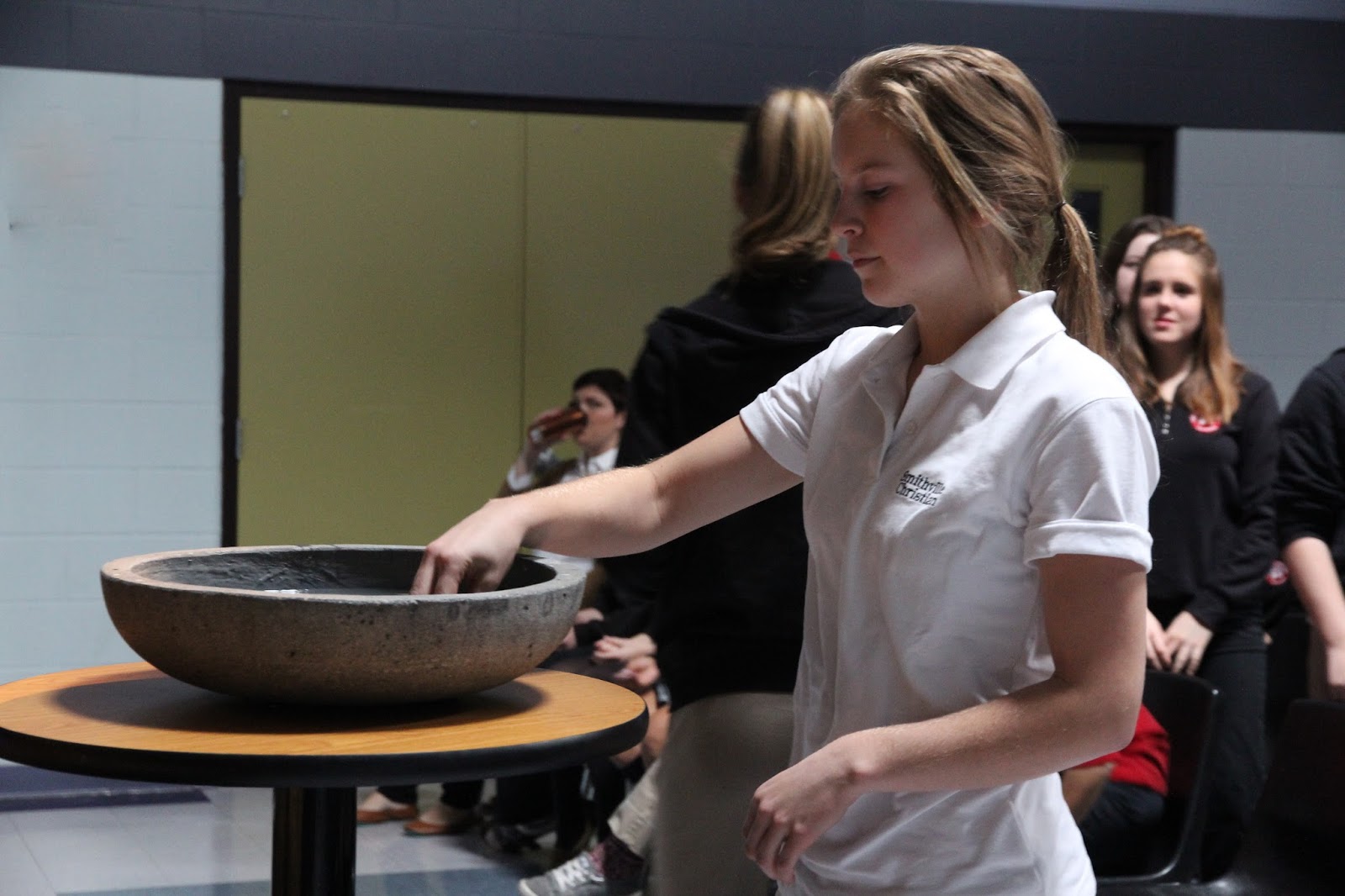
De Jong invited students and guests to come forward to dip their hands into a basin of water, representing the cleansing water of baptism, and to take from the bowl a pebble to remind them of their city. She asked them to reflect on the corner of their world – sports team, or family member, or co-worker or friend – for whom they could be praying.


“We are not here to go to heaven,” said Spiritual Life Director Gord Park. “We are here to bring the kingdom of heaven to earth.”
* * *

A student praise team led in worship with “Stars,” ”We Believe,” and “This is Amazing Grace.” 

Spiritual Emphasis Week continues with two more chapels: Thursday morning at 9:30 and Friday at 9. Guests are always welcome. Students are also participating in daily discussion groups, meeting with translators who speak Korean and Mandarin, and visiting the prayer room. The week will close with a Friday afternoon concert by FM Reset.

To contact Laura de Jong or to find out more about where she's been or where she's going, check out LauradeJong.

Tuesday, 22 November 2016

The gift of story and grace

There was a time when Laura de Jong was not happy to be Dutch.

Speaking during the second chapel of Spiritual Emphasis Week at Smithville Christian High School, de Jong said when she was a young girl, she thought she'd much rather be Scottish.

"I watched Scottish dramas on BBC, listened to Celtic music and, when I was 12, I even started learning Gaelic," she said.


But de Jong's attitude toward her ancestry changed after she spent a summer in The Netherlands.

Guided by maps, photographs and directions given to her by her father, de Jong retraced the steps taken by her grandparents and great-grandparents, visiting the villages, attending the churches and listening to the stories that had shaped her roots.

"Through these stories I discovered who I was,” de Jong said. “My family's history became my history. "Now I am wholly and unapologetically Dutch."

DeJong said stories "shape our identity. They remind us who we are and where we came from."

The Israelites had stories too – of how God had chosen them, rescued them and protected them. Yet, by Chapter 2 of the Book of Jeremiah, "they had stopped telling their stories."

They had forgotten who they were, and even worse, they had forgotten who God was. They began worshipping the gods of their neighbours.
De Jong said we might think that we would never do such a thing, but we live in an age where it's very easy to become confused about our identity. 

"Today, belief is simply one option among many," she said, and even people who call themselves Christians are often content to put God in a neat Sunday box.

It's also easy to let our identities be shaped by how others see us, or to believe our culture’s messages that we can create our own identities, she said.

"You do you, YOLO, it's your party, express yourself."

When what you wear or who you're dating or your personal self-fulfilment become more important than your commitment to something because it's right, you are in danger of forgetting your story, de Jong said.

God’s message to the Israelites is harsh: he accuses them of making his heritage an abomination and warns that even their children’s children will suffer for what they have done.

But God doesn't stop there. Jeremiah's message, as harsh as it seems, is actually a reminder of their story.

"God offers them, and us, a way back,” de Jong said. In reminding them of the story of God’s love and faithfulness, Jeremiah reminds us too.

And God’s story of grace in our lives isn’t always dramatic or shocking.

“God extends his grace to us in the humdrum things we do, day in and day out. This is good news, friends. God’s grace is everywhere and grace comes to us as we tell our stories.

Our story is that we are beloved children of God, forgiven and made new. How popular we are, or who we are dating, or whether we are a homebody or an adventurer does not matter.

“Our story is not about reputation or earning a place. Our story is a gift.

“God loves you and that is who you are.”

* * *
A student praise team led in worship with “Awake My Soul,” “Heroes,” and “Beautiful Things.”

Spiritual Emphasis Week 2016 features chapel every morning at 9 a.m. (Thursday at 9:30), extended time for daily devotions and discussion, a prayer room and a Friday concert featuring FM Reset. Everyone is welcome to chapel.


To contact Laura de Jong or to find out more about where she's been or where she's going, check out LauradeJong.

Monday, 21 November 2016

Can you be inadequate and still be a disciple?

Jeremiah was just a teenager when he was tapped by God for a difficult job, students at Smithville Christian High School were told. 

Speaking at the first chapel of Spiritual Emphasis Week 2016, speaker Laura de Jong read Jeremiah 1 and said Jeremiah’s response to God was that he was not up to the task.


Just as de Jong, a reluctant runner, did not feel she was capable of running a half-marathon, Jeremiah did not feel he was capable of being God’s agent of doom to an audience of people who would definitely not want to hear his bad-news message, she said.

God’s people had broken their covenant with God and their near future included only death and destruction, de Jong said. But over Jeremiah’s protests, God’s response was “trust me. I got this. Just do it.”

What does that mean for us?

“Most of us are not called to be prophets in the traditional sense,” de Jong told students, “but all of us are called to be disciples.”


And just as de Jong accepted her friend’s challenge, downloaded a training app and bought new running shoes, Jeremiah did the things God told him to do. De Jong followed the app’s instructions, improved her stamina in small doses, and finished the race. Jeremiah obeyed God and confronted the powerful leaders of his day with the prophecies of impending disaster. But luckily for Jeremiah, he didn’t need an app or a six-point plan “because God was in control, not Jeremiah.”

Today, discipleship might require us to be counter-cultural, to remind people that they can’t buy happiness, that they can’t secure their safety or position at the expense of someone else, or that the people who think they have power or influence are not really in control because God is, she said.

“This is hard to do,” de Jong admitted. “It’s not going to make you popular or make you friends in high places.”

It’s also hard to do because it doesn’t always seem like God is in control, she said. There are conflicts on a global level, refugees fleeing their homes, ecological destruction, environmental disaster, starvation, parents who divorce, friends who have car accidents, sickness and uncertain futures after high school or post-secondary studies.

Yet it would be worse to think that we are in control, de Jong said, to think that we can rely on the latest smartphone, clothes, friends or career path.

“There is very little direction when following God’s plan, no charts or six-point plans for success,” she acknowledged. “But the beauty of God is that he is God and we are not.”


Twice God assures Jeremiah that he will be with him, and the same is true for us, even if we feel inadequate.

“God is with us and we are with God,” she said. “We don’t need to figure it out or have a plan or know how it will work out. God has the plan and we only need to run the distance that is needed for the day – walking if necessary.”

Sometimes, God’s provision is best seen in hindsight, she said. In Jeremiah’s case, we know how the story ended, that God rescued his people and sent a prince who died and rose again to save the whole world.

“We have a God who says ‘you are with me, I’ve got this,’ “ de Jong said.

“So lace up your shoes and follow.”

* * *
A student praise team led in worship with "Build Your Kingdom Here," "Good, Good Father," and "Holy (Wedding Day)."

Chapel continues every morning this week at 9 a.m. (9:30 on Thursday). All are welcome.


 * * *
More about Laura de Jong           
Laura de Jong grew up in St. Catharines, and attended Beacon Christian High School. She studied History, English, and Congregational Ministry Studies at Calvin College in Grand Rapids, Michigan, where she also led worship and worked in residence life. Laura is finishing up her Masters of Divinity at Calvin Theological Seminary, and hopes to do church ministry after graduation. She's a staunch defender of all things Canadian, is enjoying finally learning how to cook, and believes next year belongs to the Blue Jays.

To contact Laura de Jong or to find out more about where she's been or where she's going, check out LauradeJong


Wednesday, 9 November 2016

I believe God can make a way for me


Antonia Silvini was 12 years old when she began living on the streets.

An orphan, with two younger siblings, she was being raised by her grandmother, who struggled to provide for her grandchildren because of her poverty and her age.
Silivini, who is now in Grade 11 at Smithville Christian High School, spoke at a school chapel recently, explaining how fending for herself on the streets of Mwanza, a city in Tanzania, was easier than the hard labour of doing laundry by hand for rich neighbours.
“Life was so difficult for me and I started walking around on the streets. I met other children like me and they taught me how to drink and smoke,” Silivini said. “I didn’t have anything to do so I started a new life, like those children on the street.”

But her grandmother, who wasn’t able to feed her, decided that she still wasn’t willing to let her grandchildren go.

“She looked for people who were able to help us,” Silvini recalled, arranging to have the director of a local orphanage take the children in.
At the orphanage, Silvini stopped smoking, obeyed the rules, and started going to school. More importantly, “they started to teach me about the word of God, and to pray.

“When I got to the orphanage, I didn’t know anything about God, but then my life changed.”

Silvini was in Form Four at school (equivalent to Grade 10) when her education came to an abrupt halt – there was no more money for school fees.
Instead of giving up, the teenager “kept my time in prayer and God responded to my prayers.”

Like fellow orphanage resident, Lau Mussa (read his testimony here), Silvini met Dunnville’s Bethany Ricker and her uncle, David Emiry, who were in Tanzania in 2015, volunteering at Watoto Wa Orphanage.
“Through David and Bethany, God made a way for me to be here in Canada,” Silvini said. “I thank God that he made a way for me.”

Silivini said she couldn’t believe that Bethany’s parents in Canada (May Lynne Emiry Ricker and Brian Ricker, whose children attend Smithville Christian High School) were willing to host her and make it possible for her to go to school here.
“I was wondering, is this true or a dream? But I kept praying, because it was so amazing to me.

“And now I am here in Canada for further education,” pursuing her dream of becoming a nurse. Now Silvini knows that “God can make a way for me.

“I love you,” she told students at Smithville Christian. “Thank you. I am so thankful to be studying at this school.”

Spiritual Life Director Gord Park told students that Silvini’s story demonstrates that whatever their situation, “God is still the God of miracles.” Park said many times God’s miracles flow through human hearts of love, “and whatever your situation is, no matter how desperate your situation, just take it to God in prayer.” Just as going to high school in Canada was beyond Silivini’s wildest dream, he said, “God can do immeasurably more than we can ever imagine.”

* * *
Chapel also featured a time of worship. A student praise team led in singing "Glory Bound," "I Surrender," and "Tell the World." 
We also watched a video to remember the sacrifices made to secure our freedom, and thanked God for the blessing of Canada.